By James Mitchell
Cattle markets have enjoyed supportive supply and demand fundamentals but have also had to navigate several disruptive events, including the announcement by Tyson Foods of the closure of a beef processing plant in Lexington, Nebraska, another Texas beef plant shifting to a single full-capacity shift, and rising detections of New World Screwworm in Mexico (NWS). Both carry important implications for regional cattle prices through processing capacity and trade flows.
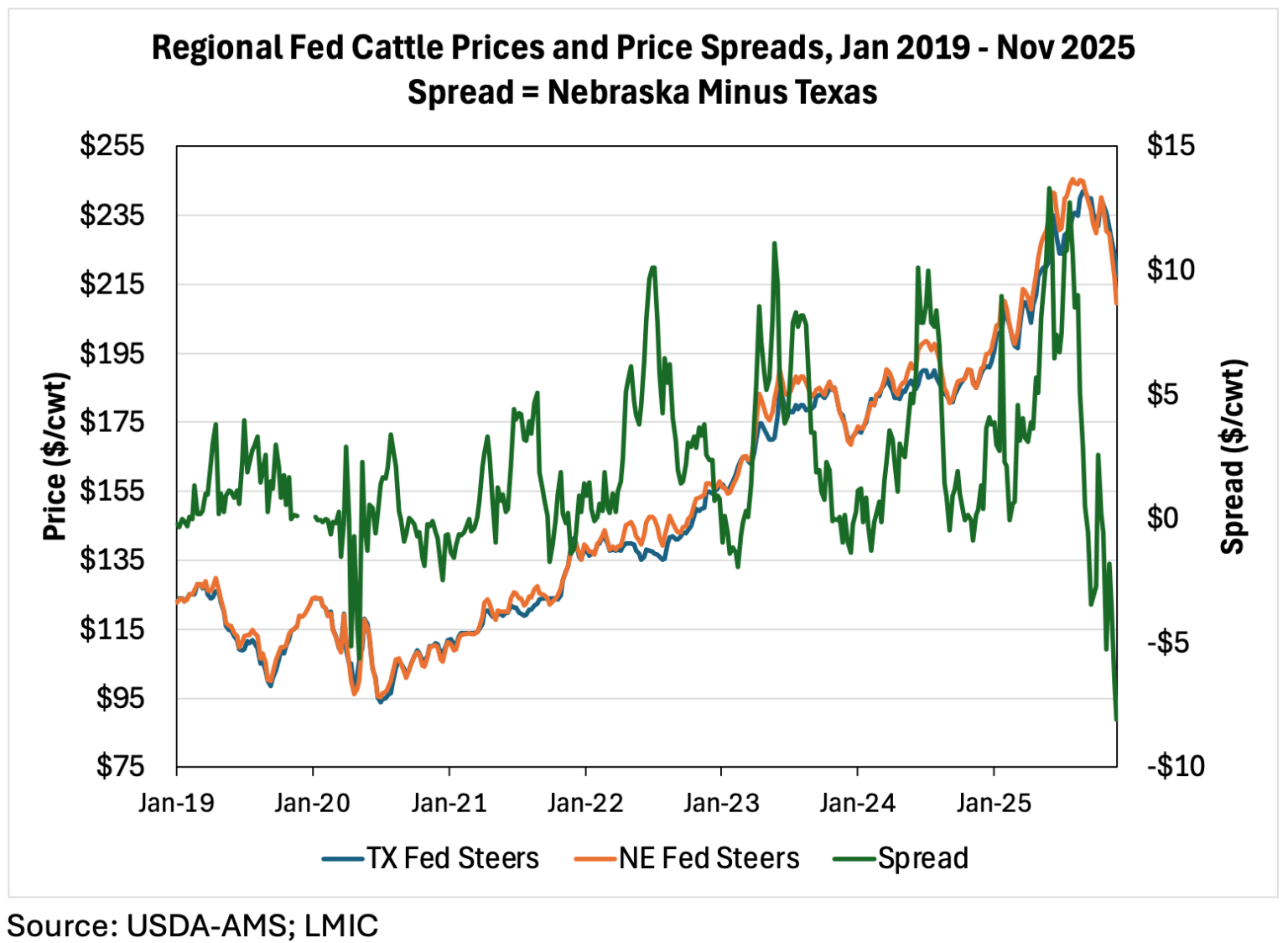
For fed cattle, the closure of the Lexington, Nebraska beef plant and reduced shifts at the Texas plant represent a decline in demand for fed cattle in those regions and, all else equal, place downward pressure on prices. These changes in processing capacity also negatively affect feeder cattle prices, though that impact is lagged. The first graph (above) in this article shows the relationship between Nebraska and Texas fed steers. The spread (green line) is calculated as the Nebraska steer price minus the Texas steer price. A narrowing of the spread reflects stronger prices in Texas, while a widening of the spread reflects stronger prices in Nebraska.